Home › Advice › Polybutylene Pipe: How to Spot the Gray Plastic and Plan a Re-Pipe
Polybutylene Pipe: How to Spot the Gray Plastic and Plan a Re-Pipe
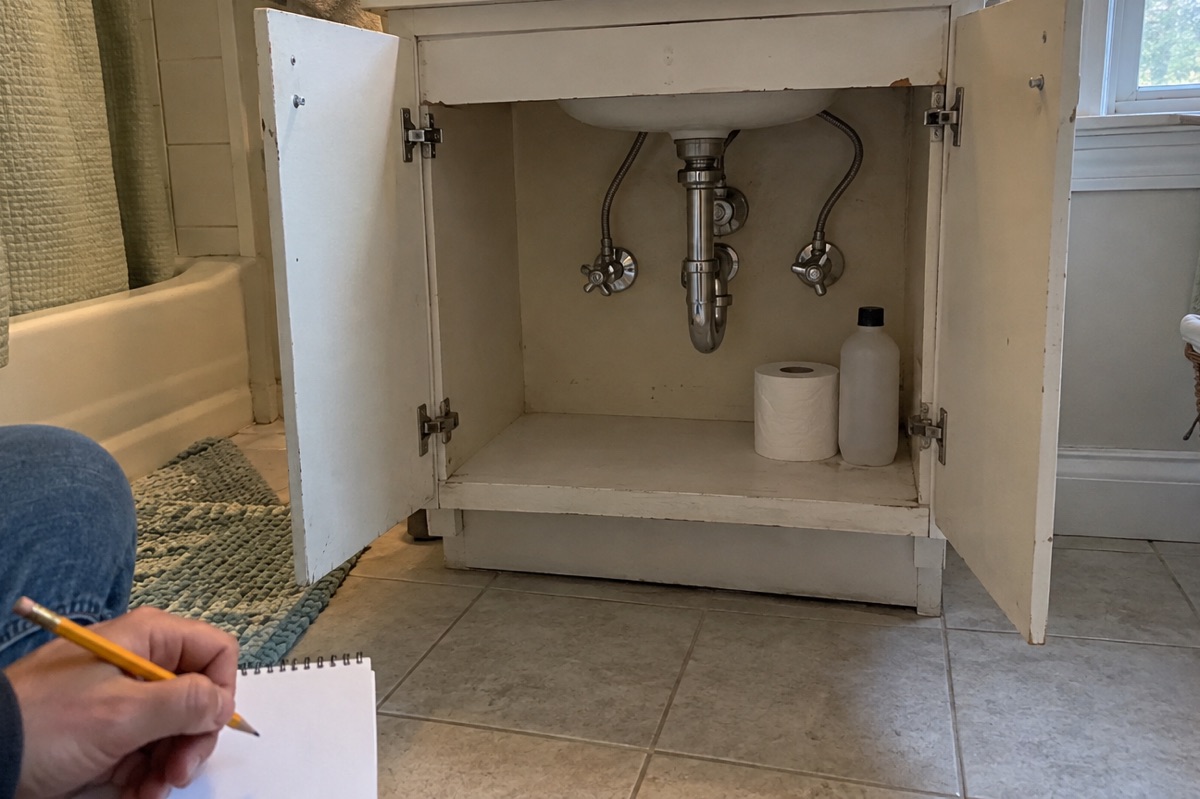
Go to the water heater first. Look at the pipes coming out of it, under the kitchen and bathroom sinks, and at the main shutoff. Polybutylene, or PB, is a somewhat flexible plastic pipe. It's usually gray, sometimes silver or black. Small copper or aluminum rings hold its joints. PVC and CPVC are the stiff white or off-white kinds. Don't bend, twist, or tighten anything. If you think you see PB, have a licensed plumber confirm it, and call your insurance agent before you buy or renew.
The three-spot walk
You only look at pipe you can see. No cutting, no crawling, no moving insulation. If a pipe or fitting is leaking right now, use your confirmed main shutoff if you can reach it safely, and call a plumber. Stay out of water near outlets, cords, or the water heater.
- Water heater. Look at the cold and hot lines where they meet the tank. Look at the wall or ceiling they come from.
- Under sinks. Open the cabinet. Look at the pipe that comes out of the wall or floor and into each shutoff valve. The flexible line above the valve is a fixture connector. It isn't the house pipe.
- Main shutoff. Find the pipe that brings water into the house. Look at the pipe on the house side of the valve. If you don't know where the valve is, use the main shutoff guide.
The settlement center's release says PB might sit in an attic, a crawl space, or a water heater closet, often under insulation. So a clean look at three spots doesn't prove there's none. Treat it as a first pass. The free House Decoder shows whether PB was common for your build year or decade.
Tell PB from the other plastics
| Pipe | Look | How it runs | Printing |
|---|---|---|---|
| Polybutylene (PB) | Usually gray, sometimes silver or black. Gray or white plastic, or copper or brass, insert fittings held by a crimp ring about the size of a quarter. | Can run in curves. | May include PB2110 or ASTM D3309. |
| PVC or CPVC | White or off-white. | Rigid runs. | Read it. |
| PEX | Flexible plastic, like PB. | Can run in curves. | Read it. |
Don't squeeze or flex pipe to test it. Color alone can't settle it, since PB itself comes in more than one color. Read the printing. If there's no printing you can see, or you're not sure, let a licensed plumber confirm it. Photos help.
What went wrong in some PB systems
A plastics trade group, the Plastics Pipe Institute, explains it plainly. PB came to North America in the 1970s. By the 1980s some systems had early, brittle failures. Many failures were traced to the plastic (polyacetal) insert fittings. Some pipe failures were traced to hot chlorinated water. A standard test for that didn't exist yet.
After lawsuits and settlements, makers stopped selling pipe-grade PB resin in North America. The PB product standard was withdrawn in 2010. The group says PB has since been removed from U.S. and Canadian plumbing codes.
A leak inside a wall can run for a long time before you see it. If your water bill jumps, or you hear water with everything off, try the two-hour meter check. Water at the base of the heater has its own first steps.
The insurance problem
Florida's state-created insurer, Citizens, will not write a new policy on a home more than 20 years old that has PB. Its FAQ lists six policy forms, including the standard HO-3 homeowners form.
A second FAQ says homes more than 20 years old need a 4-point inspection. It says active leaks, unrepaired water damage, and PB make a home ineligible. The 4-point form asks the inspector to check the pipe types, with PB listed by name. It also asks whether the home was fully or partly re-piped.
Two other Florida insurers put it in their guides. Universal's 2018 guide says no polybutylene on most of its forms. Anchor's 2019 guide says PB is ineligible. Both guides predate 2020, and every insurer writes its own list. Universal's guide also limited older PEX at the time. That's a reminder to ask what pipe your insurer accepts before you sign a re-pipe contract.
InterNACHI's standard says a home inspector isn't required to determine whether polybutylene is present. Florida's rules for licensed home inspectors list pipe materials among the plumbing parts they must inspect and report, when the pipe is visible and easy to reach. So ask directly, and ask for the answer in writing.
The settlement deadline has passed
The class action, Cox v. Shell Oil, covered PB installed between January 1, 1978 and July 31, 1995. The court-appointed center said PB went into an estimated six million homes in those years. Its program paid to replace PB for owners with qualifying leaks. The claim deadline was May 1, 2009. That deadline has passed. A re-pipe today is on you or, sometimes, the seller.
Plan the re-pipe
A re-pipe is a licensed plumber's job. Don't cut into walls to look, and don't try to swap a fitting. Use this list to shape the quote:
- Whole house or part? The 4-point form asks whether the home was completely or partially re-piped. Citizens' rule is about whether any PB is present, so a partial job may not clear it. Ask the plumber to list what stays.
- What pipe goes in? Ask what the quote uses and what your insurer accepts. Get the insurer's answer before you sign.
- Permit and inspection. Ask whether the job needs a permit and who pulls it.
- What's included? Wall and ceiling openings, patching, the main shutoff valve, water heater connections, and cleanup. Ask what's not included.
- Proof for the file. Ask for an invoice that names the pipe material and says whole house, photos before the walls close, and the permit record. Put those items in the written contract too.
- Water off. Ask how long the water will be off and whether the heater must be shut down first.
Run the plumber through the license lookup steps before you pay a deposit.
Before you close on a house
Ask the seller for any re-pipe permit, invoice, or photos. Ask whether it covered the whole house. Ask your inspector to look for PB at the water heater and main shutoff and to say so in the report. Then call your insurance agent early, before your inspection period ends, with the pipe type in hand.
Quick answers
- What does polybutylene pipe look like?
- PB is a somewhat flexible plastic water pipe, usually gray and sometimes silver or black. Its fittings are held by small copper or aluminum crimp rings. It is not the stiff white or off-white PVC or CPVC pipe. Printing on the pipe may include PB2110 or ASTM D3309.
- Can I still file a polybutylene settlement claim?
- No. The class-action settlement covered PB installed between January 1, 1978 and July 31, 1995. Its claim deadline was May 1, 2009, and that deadline has passed.
- Will a Florida insurer cover a home with polybutylene?
- Citizens will not write a new policy on a home more than 20 years old that has polybutylene. Two other Florida insurers' guides from 2018 and 2019 also exclude it on their main home policies. Each insurer sets its own rules, so ask your agent before you buy or renew.
Keep your home plan moving
Get the free Seasonal Home Maintenance Schedule
A seasonal checklist for your roof, gutters, HVAC and more, plus practical homeowner tips. Adjust the schedule for your climate and equipment.
We don't sell your email address. See our privacy policy.
Sources
- Polybutylene settlement press release and court notice in Cox v. Shell Oil (June 11, 2008) — Consumer Plumbing Recovery Center (court-established settlement administrator)
- TN-31 Differences Between PEX and PB Piping Systems (2017) — Plastics Pipe Institute (industry trade association)
- Will Citizens insure dwellings with polybutylene pipes? (FAQ 1713, updated January 26, 2026) — Citizens Property Insurance Corporation
- Does Citizens require a plumbing inspection? (FAQ 1360, updated February 25, 2026) — Citizens Property Insurance Corporation
- 4-Point Inspection Form (sample form Insp4pt 03 25) — Citizens Property Insurance Corporation
- Home Inspection Standards of Practice (revised October 2022) — International Association of Certified Home Inspectors
- Rule 61-30.801 Standards of Practice, General — Florida Administrative Code (Department of Business and Professional Regulation) via Cornell LII
- Rule 61-30.806 Standards of Practice for the Plumbing System — Florida Administrative Code (Department of Business and Professional Regulation) via Cornell LII
- Florida Underwriting Binding Guidelines (10-24-18 edition) — Universal Property and Casualty Insurance Company
- Underwriting Reference Guide for Florida Premier Homeowners (V20191216) — Anchor Insurance